|
THE BOOK OF LISMORE
|
Lismore is a town in Co. Waterford, situated on the
River Blackwater, at the foot of the Knockmealdown
mountains. It is located approximately 119km
from Cork and 22km from Dungarvan on the N72.
Lismore dates back to 636 when St. Carthage
arrived and established Lismore Abbey. |
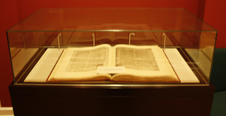
The Book and
a crozier were discovered hidden in a secret
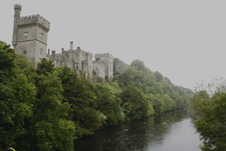
recess in the walls of Lismore Castle, Co.
Waterford by workmen in 1814. They were enclosed
in a wooden box in a built-up doorway. The
Castle of Lismore was built in 1185.
The Book of Lismore is in Chatsworth House
in Derbyshire in England, the main residence
of the Duke of Devonshire, who also owns Lismore
Castle.
The
Lismore Crozier can be viewed in the National
Museum of Ireland.
THE BOOK OF LISMORE and "The Siege of Knocklong"
The
Book of Lismore contains the text of
"The Siege of Knocklong", a battle
between Cormac mac Airt and Fiachra Moilleathan,
and stories of the druid, Mogh Roith.
THE BOOK OF LISMORE and "The Travels of Marco Polo"
Lismore Crozier
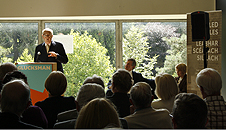
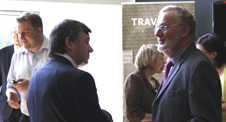
The
Chatsworth Settlement Trust lent the
book to University College Cork. The Exhibition
"Travelled Tales - Leabhar Siúlach,
Scéalach" took place at the Lewis
Glucksman Gallery from
July 22, 2011 to Oct 30, 2011.
The Book of Lismore also known as the Book
of MacCárthaigh Riabhach (Leabhar Mac Cárthaigh
Riabhach) was translated in 1890 by Whitley
Stokes.
In 1950, Irish Manuscripts Commission published
an edition of the manuscript with an introduction
by R. A. S. Macalister.
The Book of Lismore is a vellum manuscript
consisting of 198 folios, written in medieval
Irish and composed around 1480, not for a
monastery but for a lay patron.
The Book of Lismore was written in the fifteenth
century for Finghin Mac Cárthaigh Riabhach
and his wife Caitlín. It was compiled
in Timoleague and came into the possession
of the Earl of Cork at Lismore Castle after
a siege in the 1640s. It remained there until
it's discovery in 1814.
It contains secular
and ecclesiastical texts. The Book contains
the text of The Siege of Dámgháire/Knocklong.
It also contains a copy of the Travels of
Marco Polo, the lives of the Saints, including
Patrick, Colmcille, Brigid, Senán, Ciarán
and Mochua, a copy of An Teanga Bithnua (The
Ever-New Tongue) the title of a dialogue between
the Hebrew sages and the apostle Philip.
The Book also contains the Poems of Saint
Molaise, The conquests of Charlemagne, a History
of the Lombards, a copy of Lebor na Cert (The
Book of Rights), on the taxes and tributes
of the kingdoms of Ireland, The Triumph of
Cellachán of Cashel "Caithreim Cellachain
Caisil" on the wars between the Norse
and the Irish, a medieval account of Antichrist,
stories of Queen Maeve and The Táin and tales
of Fionn mac Cumhaill from Acallamh na Senórach
(Colloquy of the Ancients)
|
The
Siege of Knocklong has been translated into
English by Seán Ó Duinn.
Forbhais Droma Dámhgháire, The
Siege of Knocklong (Mercier Press. Cork, 1992). |
| History
of Lismore |
| More
History of Lismore and information on the town |
| Lismore
Tourism |
|
|
|